

spudoogle

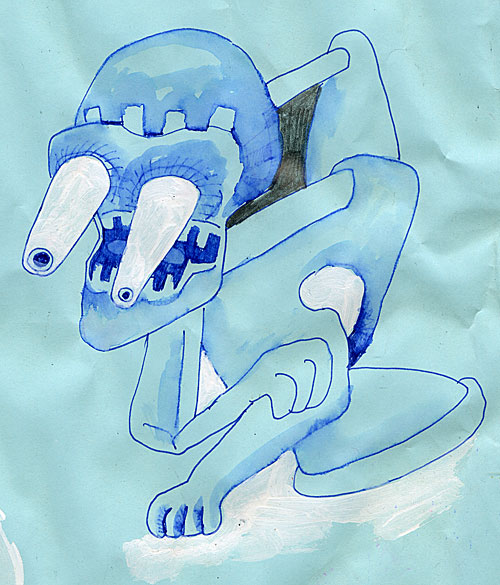
francis_ekbike_screenshot

Screencap of animation - the moving version on spudoogle.com writhes, wobbles and rotates in a self-contained ballet of antipodean "wrong motion."
From Mike Francis, whose TM-ucce blog is no longer being updated.

Francis, Jeffrey Henderson, Jasper Elings and others make a convincing case for twisted uses of Autodesk Maya and its equivalents. Still making mental notes for an essay on self-aware uses of failed modeling "as art."
The Cage is not the Menagerie

Alan N. Shapiro has written brilliantly on Star Trek's Captain Pike as an early traveler in virtual reality. Pike appears in the Hugo-winning two-part Original Series episode "The Menagerie": horribly disfigured and paralyzed in a spaceship mishap he returns to a planet where he had once been imprisoned as a zoo specimen by reality-shifting aliens. The Talosians want to groove on the violent and sexy adventures they pull out of his mind as they keep him prisoner for his entire mortal life. Earlier in his career they had deemed him too wild to be caged but now that his body is wrecked he chooses their form of escape, in order to give his mind the freest possible reign.
Fans know that "The Menagerie" cleverly remixed Gene Roddenberry's original series pilot "The Cage," wrapping the early Pike story inside a new one from his life after the tragic accident. "The Cage" is now viewable on Netflix and it's fascinating to compare how the wrapper story changes the narrative.
Let's consider "The Cage" from the point of view of Vina, a woman trapped by the Talosians prior to Pike's arrival on the planet. Her happy ending in "The Cage" differs greatly and I would say chillingly from the one she receives in "The Menagerie."
When Vina is a child her colony's spaceship crash-lands on Talos. Only she survives, mangled beyond recognition. The Talosians have never seen another living human so they put her back together very badly; she is a kind of Frankenstein's monster. In virtual reality, however, she is beautiful, and the Talosians kidnap Pike from the Enterprise hoping he will mate with her to give them more human playthings. Pike is kind of a brick, though, married to his ship and work, and he resists her charms in one proto-holodeck scenario after another. Vina thinks she sees glimmers of interest and is convinced he will eventually accept his confinement and come to love her.
The Talosians have no patience, however, and in one of the pilot's most jarring surprises they instantly beam into Pike's cell two female Enterprise crew members, both with unrequited love fantasies for him. Vina wails her jealousy and betrayal - Pike was hers. Instead of the Bacchanale the Talosians hoped for Pike gains confidence having his crew beside him (he's not attracted to the new women, either) and eventually finds a way to thwart the aliens.
At this point Pike learns Vina's true form, which we're shown in a slow Jekyll-into-Hyde transformation montage, and understands that she will not be leaving the planet with the Enterprise crew. In the creepy ending of "The Cage," she is once again made to look beautiful and is now joined by a completely fake but stunningly handsome Captain Pike, who will be her VR companion for the rest of her days. The Talosians give her a synthetic version of the love she couldn't achieve herself. The real Captain Pike doesn't seem to object to this double. (Nowadays we might ask - is it a software copy? How much did the Talosians record from the real Pike - everything? Is he alive?)
In "The Menagerie" the ending of "The Cage" becomes much more warm and fuzzy. When we see the happy, restored couple heading back to their underground vault we know Pike is Pike, he is there by choice, and Vina won him fair and square.

Update: Alan Shapiro compares "The Cage" and "The Menagerie" on his blog [link removed -- see below]. The link in the first paragraph above is to his first essay on Pike, from the 1990s. The blog post incorporates writing from the earlier essay.

More.

Update, June 2018: Shapiro appears to have taken down his Cage/Menagerie post. I removed the link to it.

"Logan's Fast Walk"

"Logan's Fast Walk" [mp3 moved to Bandcamp]

More minimal techno (with a handful of bass and lead riffs) similar to "Swim With Dolphins, Run With Logan."
About 4 minutes. All digital: Reaktor GoBox and Lazerbass, mixed in Cubase.

slight edits to post

Lefort, Lenin, and other alternatives

Alan N. Shapiro's essay on political philosopher Claude Lefort deserves a look. It's more reminiscence of the role Lefort played in Shapiro's thinking than summary of Lefort's writing but the nut of it is here:

This is a generalization, but many thinkers and political actors who were radical in their youth give up their radicalism as they grow older and become liberals. I can’t help but think of Joschka Fischer – the former leader of the German Green Party and Foreign Minister of Germany from 1997 to 2005 – as a prime example of this. Fischer went from being an opponent of war to being a “leader” of wars in Serbia/Kosovo and Afghanistan. The point is to not give up radicalism for liberalism, but rather to be an advocate of both. To understand how the strengths and best values of both can be united.

Shapiro mentions both Lefort and Richard Rorty as exponents of a liberal/radical hybrid and explicitly rejects recent arguments of Slavoj Žižek's in favor of "repeating Lenin" (see, e.g. this essay), Shapiro writes:

BIG MAN on CAMPUS Slavoj Žižek recently published a couple of books celebrating Lenin, and he has recommended that we turn to Lenin.

Žižek is a funny guy, so it must be a joke. But I don’t get the joke. Lenin was a mass murderer.

Lenin crushed the workers’ councils in factories that were the real heart and soul of the 1917 Russian Revolution. Lenin crushed the movement led by Nestor Makhno in the Ukraine which fought against both the Red and White Armies, resisting state authority, whether capitalist or communist. Lenin crushed the rebellion of the Kronstadt sailors in the Gulf of Finland in 1921. All these repressive acts established the precedent for the suppression of workers’ uprisings by Khrushchev in East Germany in 1953 and in Hungary in 1956, and by Brezhnev in Czechoslovakia in 1968.

Some Marxists (I guess Žižek is one of them) believe that Lenin was a brilliant Marxist theoretician. This must also be a joke. Lenin’s second most famous book, after What Is To be Done?, is called State and Revolution. Read this book and you’ll see that Lenin’s so-called “theory of the state” is a non-theory. Lenin’s theorization of the capitalist state is that the state is an “instrument” of the capitalist class (the bourgeoisie). That’s it. He has nothing more to say about the state. That this was the alpha and omega of what Lenin had to say about the state is clearly stated by much more sophisticated Marxist theorists-academicians, in books like The State and Capitalist Society and Class Power and State Power by Ralph Miliband (the father of current British Labour Party leader Ed Miliband) and in essays on the Marxist theory of the state by New York University political science professor Bertell Ollman.

Lenin grants no “autonomy” to the state in his theorization of the state under capitalism. As a theory, it is crude and reductionist, a so-called “reflection” theory. Naturally it follows that Lenin is not going to be the guy to have any theory of the post-revolutionary state. Since the capitalist state is nothing but an instrument of the bourgeoisie, therefore the communist or socialist or Marxist or revolutionary state is going to be, for this blind man, nothing more than an instrument of “the revolution.” Since the revolution is “good,” the revolutionary state must therefore be “good.” Puke! Vomit! Barf! Zum Kotzen!

Shapiro recommends Bernard Flynn's book on Lefort; I am reading it now and will attempt a summary when I'm done. The chapters on Lefort's reading of Machiavelli inspire. Per Lefort, Machiavelli recognized early on that class struggle is inherent in every society, even ones traditionally anchored in religious principles or aristocratic succession. "The Prince" aligns himself with the people against the grandees but provides order through projection of strong leadership. Even princely societies need outlets for public grievances, and Lefort suggests that Machiavelli was subversively calling for revival of a mechanism along the lines of the Roman tribunal (flouting the aristocrats of the day, who stifled dissent while idealizing Rome). Lefort's Machiavellian studies inform his other writing, which sees totalitarianism as a modern aberration -- even more pathological than old-fashioned tyranny in that it perversely tries to suppress conflict and class struggle by defining them out of existence.