
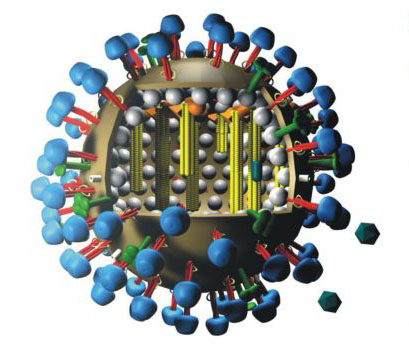
...or so it is known to all but the pork industry, which is lobbying to call it the "hiney" virus (H1N1).
the succulent diagram is from wikipedia
Reasons you might consider foregoing that bacon sandwich you were planning to eat today. Not because you catch the flu from eating pork but because factory farming of pigs has become increasingly heedless of public welfare.
Unlike the US and many European countries, Denmark has laws that cap the number of pigs per farm and put a ceiling on the total number of pigs allowed to be raised in the country, because
"Influenza [in pigs] is closely correlated with pig density," said a European Commission-funded researcher studying the situation in Europe. As such, Europe's rapidly intensifying pig industry has been described in the journal Science as "a recipe for disaster." Some researchers have speculated that the next pandemic could arise out of "Europe's crowded pig barns."
An expert in flu virus evolution says confining pigs and poultry in cramped bunkers, near each other, with human staff between them that never rotates is a recipe for crossbreeding truly nasty, persistent viruses that potentially jump from animals to humans.
Washington's answer is spin: calling the recent flu outbreak a series of letters and numbers instead of "swine flu," which offends the pork industry.
(thanks to Charles Lemos at MyDD for the post linked to and recapped here)
Michael Bell-Smith has moved his online vitae-slash-archive to michaelbellsmith.com from its former location. Worth a look--am especially happy to see some of the work linked to on my old blog back up, such as Video Created to Fix Stuck Pixels in Computer Monitors Recast (with Soundtrack and Sunset) as Video to Fix Your Stuck Mind. Also good to see some of the newer work such as Faceted Sphere on an Escalator, a sophisticated variant of the venerable chrome sphere on checkerboard motif.
Clear, detailed, sobering chart from New Scientist shows how many years' supply is left of various minerals (zinc, copper, germanium, etc) if:
--the world consumes these materials at the current rate and
--if the world consumes them at half the current US consumption rate.
Also considered is how much each metal is currently recycled.
It's fair to say several will be mined out in our lifetimes. Any science fiction writer worth his or her sodium chloride can imagine that our future economy will be based on the barter value of various used-up metals, and the rise of feudal systems based not on land but hoarded recyclables in the hands of technologically endowed elites.
ginormica at Nasty Nets (the cyborg in popular culture)
web art preservation at Nasty Nets
Carolyn Swiszcz paintings at... Nasty Nets
discussing a famous NY cyber conceptualist's talk in Toronto that apparently went over like a lead Hindenburg. The subject of Net Art 1.0 vs 2.0 came up so had to refresh my memory by looking at a textbook history:
I am re-skimming some of Rachel Greene's book Internet Art. She seems to have been sleepwalking in some of her descriptions of the early work. She calls Lialina's 1996 piece My Boyfriend Came Home From the War an "oblique, dramatized romantic narrative" with elements of interactivity (what Sally calls "find-the-place-to-click-me").
But to hear Lialina talk about that work in a lecture here in NY it is a Dadaist goof with a pseudo narrative (what boyfriend? what war?) that made fun of the slow loading tech of the time.Heath Bunting's King's Cross Phone In, 1994, reads to me like the prototype Net Art piece that launched a thousand Rhizome commissions. Bunting publishes a list of pay phone numbers for a London train station on the Internet with instructions to start ringing the numbers at a certain time. Passersby in London witness a "spontaneous" international phone-ringing symphony--a Situationist or Fluxus type event. It's the predecessor of the cell phone "flash mob" although Greene's 2004 book was probably too early to make that connection.
To me it says more about long-distance rates and I would assume that the "international-ness" of the calls depended on how well heeled the participants are. I'm guessing most of the calls came from within the same area code, but Greene doesn't get into the economics of it at all.
In any case that situationist stuff is mostly a great story--hearing about it is just as good as participating. That interests me considerably less than making visual art, film or music with brain dead web based tools.
