pre-Rant on formalism

Formalist art criticism and the politics of meaning
(hat tip schwarz)

Haven't read all this yet but am saving the link to come back to. Don't think this critic understands the art he or she is calling "formalist."
And possibly confuses the extremes of late Greenberg theory with the studio practices Greenberg chronicled early on.

Greenberg believed that the subjects of the visual arts should be their respective media. Painting should be about paint, and sculpture about the materials of sculpture. It follows that politics and narrative, as extraneous to the art media, debase the purity of visual art. Formalists evaluate art according to physical qualities such as color, size, shape, line, texture, and so on, and treat the ideational content of works as irrelevant. They view themselves as being mainly protectors and upholders of high aesthetic standards.

This is an idiot's view of abstract art and the reasons for doing it. Greenberg was not this unsophisticated, didactic as his later criticism became. To reject verbal narrative, theatrics, etc in art isn't to reject "ideational content." It is to recognize that the ideas of many paintings are expressed non-verbally and require new kinds of metaphors. Greenberg adopted and codified the language he heard artists using in mid 20th Century studios ("push-pull," etc.). Much of this language centered on the properties of media but only hack artists stop there. The ones who wrote, such as Mondrian or Newman, tended to the philosophical. Unfortunately, reduced to writing, you have to deal with such ideas as writing. Trained as a writer, Greenberg had little use for windy bloviation and therefore insisted on what was verifiable or falsifiable.

Abstract art is just as difficult and radical a proposition now as it was fifty years ago, and still drives social critics crazy, such that they have to make its practitioners and advocates into pedants quoting Ralph Mayer's The Artist's Handbook (a text on methods and materials) as some kind of governing philosophy.
Misc. Tracker References

as in "tracker music," very low res files played on home computer via text commands

(outgoing email) Thanks--I just saved a bass note [in Modplug tracker--woo]. I cracked up when Cubase asked me if I wanted to convert it from 8.303 Khz to 44.1 and from 8 bit to 24. Now I understand how so much info is packed into the mod files.

(another email) One of my favorite tunes on [mazemod.org] is "Groovedoos" by the Fox II. I found the .mod [for it] and opened it. In the comments it says it was made in [Dec] 1996 and the samples are "from the Roland mc-303 and my old breakbeat records--the 'aohaa' sample is from Chyrilian"

(twitter) just realized CiM has a myspace page with a tracker self-remaster of "Hitachi," CiM-ized version of "Popcorn" (!), Reference outtake & excellent, doom-y track titled "course."

(email) [UK producer CiM is] sort of Miami/Phoenicia nervous electro beats with really sweet pads. [Incredibly consistent, recognizable sound from one song to the next. CiM is the bomb.]

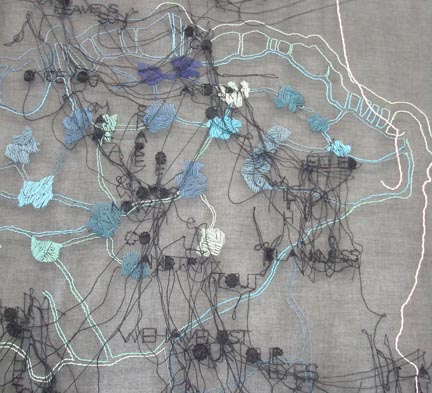
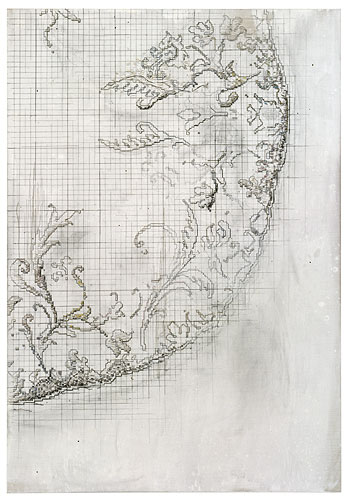
embroiderism

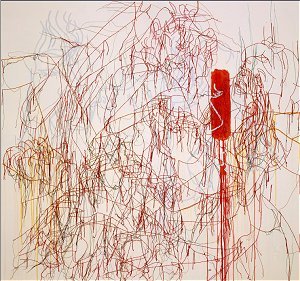
Upcoming at The Project, Jessica Rankin:

jessica rankin

Currently at Andrea Rosen, Michael Raedeker:

michael raedeker

About 10 years ago, Ghada Amer:

ghada amer

Painterly or "base materialistic" use of embroidery, among other topics, was considered in an essay I wrote in the Ghada Amer era, for an exhibition at Cristinerose gallery called "Thread."

Ghada Amer also embroiders, but her alphabet consists of the ritualized sexual poses of male-oriented pornography--girl with legs spread, girl separating buttocks, girl tonguing other girl’s labia--in repeated quasi­decorative patterns across the surface of a stretched canvas. Here, too, the thread departs from the implied continuity of the dotted line, jumping from one image to another in a meandering, random flow that recalls Pollock’s drips or Marcel Duchamp’s “standard stoppages.” Removing pornography from the dark confines of the sex-shop and spotlighting it in the gallery, then robbing it of its clarity and specificity with a kind of physical “static,” Amer’s work both reveals and obscures.

It was interesting to encounter two recent examples of this way of working within 24 hours of each other, through my email inbox and a gallery visit, respectively. Minus the porn, as far as I know.

Davis, Bevilacqua, Barney

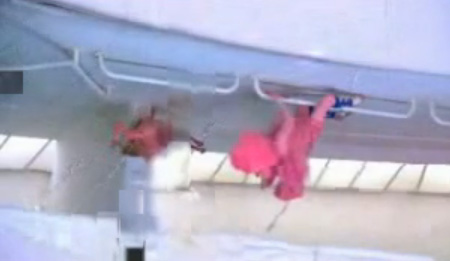
paul b davis compression study 4

Above is a still from Paul B. Davis's Compression Study #4 (Barney) /short version [YouTube]. Although the Matthew Barney video it's based on is Art that sells for the big bucks at Barbara Gladstone gallery it somehow ended up in smaller form on YouTube, and that's Davis's actual source. I saw Barney's show at the Guggenheim and may have seen snatches of the video of his wall-climbing performance there but I now mainly know the event through this YouTube, which I've watched more times. Davis's process (called "Data Moshing" by some and also seen in some recent pop music videos, although Davis did it before they did) adds some much-needed ambiguity to the Cremaster series' rather literal, theatrical surrealism. Data moshing is all about strange, temporal shifts and it's creepy, for example, to watch a cat-creature emerge suddenly out of a cloud of frozen Barney-pixels in the Davis version. As with the analog-scrambled porn channels one might have encountered surfing around the TV dial in the 80s and 90s, you tend to look more closely at what you think is there. The imagination can supply prurience or horror but Barney is the type of artist who likes to do all the imagining for you.

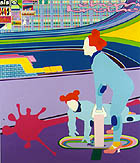
On the art-pop-culture-art loop front there are curious echoes between the Davis piece and a painting from a decade ago by Michael Bevilacqua, also dealing with Barney. This had a real transgressive frisson at the time, and rumor has it Barney was annoyed by these paintings (and, I suspect, the fact that Bevilacqua was selling them out).

michael bevilacqua

Here's what David Ebony said about that work in his Top Ten for artnet, 1997:

Perhaps the most astonishing works in the show are those based on scenes from Matthew Barney's 1994-95 film, Cremaster 4. The large painting Dig Your Own Hole shows Barney's so-called Faeries, in orange wigs and blue jumpsuits, carving a large hole on a pier, an early scene in the film. The upper left portion of the canvas is tightly packed with fragments of corporate logos, as well as a logo for the band Oasis. In these brilliant canvases it seems as if Bevilacqua has succeeded in creating a bit of instant art history. By transforming such a recent work as Cremaster 4 into a pop icon, Bevilacqua reminds viewers of, among other things, the speed at which culture can be assimilated.

This was in the super-slow world of painting and gallery practice, and now we're talking about the same things happening in seconds online.

Lisa DePaulo, Yuck

Digby's thoughts on Lisa DePaulo, the TV journalist who smeared politician Gary Condit (as a murderer, no less) and is still attacking his character after he was completely vindicated.

I can't stand to watch TV news so I missed all this firsthand. You couldn't escape the campaign against Condit, though, during the "summer of the shark," before 9/11 gave the media creeps their perfect story and two wars, to boot.

The movie Broadcast News did a good job of explaining how people with no talent other than the ability to look poised before the camera rise to positions of power in the modern world. Unfortunately the movie didn't cure people of relying on TV as the main source of their news.