McCain's Prior Banking Scandal

A CBS News article from March 2008, "Keating Scandal Still Haunts McCain," talks about earlier instances where candidate John McCain attempted to influence federal regulators on behalf of campaign contributors. One involved the FCC: McCain urged "quick consideration" of a proposed TV station purchase while an FCC commissioner's formal nomination was pending before a McCain committee. The other, rooted in the savings & loan crisis of the late '80s/early '90s, has direct relevance to the current financial meltdown:

In his early days as a freshman senator, McCain was known for accepting contributions from Charles Keating Jr., flying to the banker's home in the Bahamas on company planes and taking up Keating's cause with U.S. financial regulators as they investigated him...

Keating and his associates raised $1.3 million combined for the campaigns and political causes of all five. McCain's campaigns received $112,000. The investigation ended in early 1991 with a rebuke that McCain 'exercised poor judgment in intervening with the regulators.'...

Keating went to prison for more than four years after a federal fraud conviction. The conviction was reversed on appeal after he argued that jurors improperly had knowledge of a prior state conviction on related charges. He was to be retried in federal court but instead pleaded guilty to four federal fraud counts. Keating admitted he siphoned nearly $1 million from his S&L's insolvent parent company. He was sentenced to time he already had served.

After prison, Keating moved to his daughter's home in the wealthy Phoenix enclave of Paradise Valley. In 2006, he quietly began work as a business consultant in Phoenix. A spokesman for Keating, reached at his office, said Keating did not want to discuss the banking scandal or McCain's presidential campaign.

Keating's Lincoln Savings and Loan sold worthless, high-risk junk bonds. Many of the 23,000 investors were elderly customers who didn't realize their investments were not federally insured. Many were left destitute while Keating maintained a lavish lifestyle. Keating also participated in the risky investments that led to the collapse of S&L's across the country.

The U.S. government seized Lincoln in 1989, sticking taxpayers with a bailout cost of $2.8 billion. Many other thrifts collapsed, with taxpayers footing nearly $124 billion of the $152.9 billion bailout cost, according to the Federal Deposit Insurance Corp.

Depositors and politicians searched for culprits and turned up the five senators.

Keating sought a quid pro quo from the five. He wanted government regulators, who were investigating Lincoln, off his back. And he demanded reversal of a new rule limiting an S&L's direct investment in risky ventures to 10 percent of assets.

The banker's attitude was summed up the day a reporter asked whether his political donations to the senators encouraged their intervention.

"I want to say in the most forceful way I can, I certainly hope so," Keating replied.
Lev Manovich's Principles of New Media Considered

According to Lev Manovich's Wikipedia entry, new media has the following attributes (illustrations supplied by the present blog):

1. Numerical representation: new media objects exist as data

LoVid

2. Modularity: the different elements of new media exist independently

chiens chats

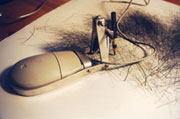
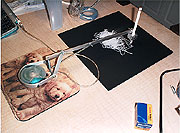
3. Automation: new media objects can be created and modified automatically

DeLappe Artist's MouseDeLappe 2

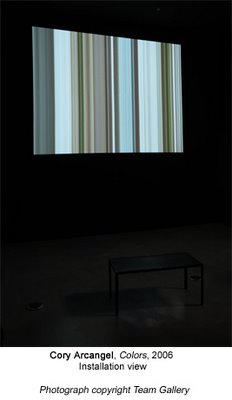
4. Variability: new media objects exist in multiple versions

participatory1

participatory3

kurt ralske

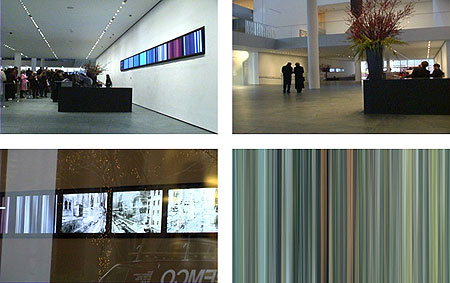
Kurt Ralske, MOMA display screens

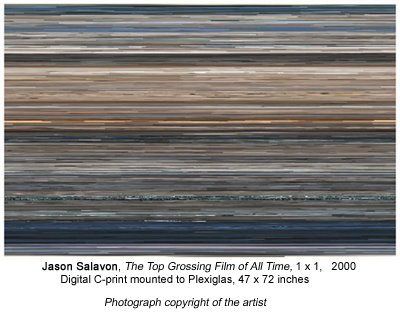
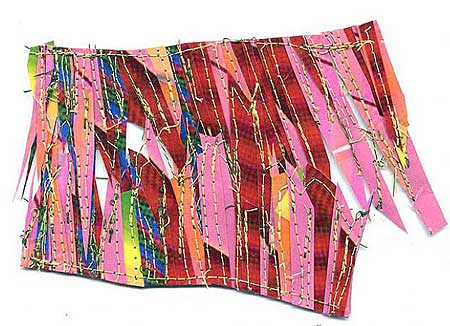
5. Transcoding: a new media object can be converted into another format

teledaisy westerman still

teledaisy westerman still (fuzzy)

SEC Doesn't Regulate Credit Swaps, Duh

It's hard to know if John McCain is stupid, a liar, or both. Regarding his call for firing the Chairman of the SEC, TAPPED says it well:

MCCAIN PROPOSES FIRING CHRIS COX.
In his latest attempt at a total makeover, John McCain said today that if he were president, he'd fire Chris Cox, the chairman of the SEC, for keeping in place "trading rules that let speculators and hedge funds turn our markets into a casino." But whatever its flaws, and they are abundant, the SEC still is constrained by federal laws -- and a number of the laws that prohibit SEC regulation of casino behavior were written by McCain's chief economic guru, former Sen. Phil Gramm, who exempted the very credit default swaps that dragged AIG down from any federal oversight.

So who does McCain want to replace Cox with? Gramm?

That's change you can grow queasy about if you think it over.

--Harold Meyerson

And as ABC notes, "while the president nominates and the Senate confirms the SEC chair, a commissioner of an independent regulatory commission cannot be removed by the president."

And as for Cox being lax, as Salon's Andrew Leonard points out (prob. subscription only):

[I]t might be worth remembering that this former Reagan administration lawyer and congressional House representative from Orange County, Calif., has been doing exactly what his party has always wanted him to do. George Bush did not appoint him commissioner in 2005 to crack down on Wall Street. The prevailing ideology of the Republican Party -- and this is one area where the historical evidence, by his own admission, does not justify calling John McCain a "maverick" -- has been to loosen control of Wall Street, not to tighten it. If our markets were turned into casinos, the majority of the blame has to go to the Republican Party, with some assistance from the Clinton administration.

Mostly Sculpture Exhibition in China

Below, a sculpture exhibition at the Median Art Center in China, photo by Kai Vierstra from his blog. Click image for larger view. His sculpture is the helix of wooden triangles just to the left of center. One thing that intrigues here is the commitment of indoor acreage to art and the predominance of abstraction in the work. Not one image of say, ironic Mao-era socialist realism to give the show figurative "balance" (with the possible exception of the painting up near the ceiling--can't see it very well).

vierstra_china52

L.M. Sums Up the Last Three Years of Good Web Art

Lorna Mills (aka L.M. from the Sally McKay and L.M. blog) is teaching a net art class and has published her class notes. It is a mix of syllabus, lesson plan, and how-to with much editorializing and distinction-making about the current scene of surf clubs, web art 2.0, or what have you.

Rather than embrace the Web Establishment with links to textbook examples of net art, Mills is marching off into the great uncharted and taking impressionable minds with her.

Subjects covered are things yours truly has been going on about for years and were only barely adequately covered at the Net Aesthetics 2.0 panels and subsequent discussions with Rhizome chatboard naysayers. Collections, arranging GIFs on pages, using tables, distorting GIFs, YouTube hacking, hackers vs defaults, Nasty Nets, Double Happiness, Chris Ashley, Loshadka, Petra Cortright. The good stuff.