My guest essay "Psychotronic GIFs," for Paddy Johnson's IMG MGMT series of blog posts, is up this morning: please go siphon it up, that is, give it a look.
My guest essay "Psychotronic GIFs," for Paddy Johnson's IMG MGMT series of blog posts, is up this morning: please go siphon it up, that is, give it a look.
Have decided to resume Twitter posting. Stopped because they limited their archive to ten pages. Was saving everything and will continue to do that on a regular basis. It is useful as a diary and virtual notepad.
So, first installment of saved posts: March to June 2008 (reverse chron. order)
Update, Feb 2011: Changed the URL. Am gradually putting up all my twitter posts as HTML pages.
BITMAP: As Good As New
catalog of the exhibition: [841 KB .pdf]
The Leonard Perlstein Gallery
Drexel University
Philadelphia PA
vertexList Gallery
New York, NY
The catalog essay "Bitmap and Vector," by "BITMAP" curator Marcin Ramocki, explores the two main ways of making images digitally. Ramocki posits them as central metaphors, or markers, in hyper-stimulated, hyper-simulated (i.e., post-Baudrillardian) visual culture. The essay is eloquent and informative but seems to be leading up to a conclusion rather at odds with the artists chosen for the exhibit:
"The vector is the more revolutionary visual unit so the artists in this show follow the path of retrenchment."
Kidding, sort of, he doesn't really say that, but Ramocki's gallery is called vertexList, which is a term from vector graphics, and there is a notable uptick in his prose excitement when describing those graphics that is perhaps lacking in his description of stodgy old horizontal-and-vertical, reality-based bitmaps. (In brief, bitmaps are grids of dots called pixels, similar to photographic "grain," while vector imaging is based on drawing curves to define shapes. Photoshop is bitmap based and Illustrator and Flash are vector based. The latter use "handles" to draw Bezier curves defined by points called "vertices.")
Here's where Ramocki really gets cooking:
Vector image essentially does away with the necessity of the "real" and the photo-optical referent. It is a child of a purely virtual formation process and a "perfect simulation," to continue the Baudrillard reference. Unlike the Photoshop filtering process that "tricks" the photo to look a certain way via a chain of intricate algorithms, a vector is infinitely pliable and non-photographic--any vertex can be repositioned along with the handles at any point. There is no claim of optical proximity to some existing universe; there is only design for its own sake.
This blog admits a certain bias for bitmaps (because they are dumb) and basic ignorance regarding vector graphics. I admired the vector-inspired "graphics revolution" of the '90s, as wrought by such collectives as Designers Republic and Buro Destruct, but still prefer the look of GIFs to the ultra-smoothness of Flash and favor the output of crappy pixel-based imaging programs such as MSPaint and Paintbrush over the sleek gradient fodder of Adobe Illustrator.
"BITMAP" has about 30 artists working with pixel-based reduction, craft, and image-dismantling. One hopes that Ramocki can one day round up all the artists bending time, space, and human understanding with vector (Paper Rad?) for a companion show: "Bitmap vs Vector: Who Will Win?"
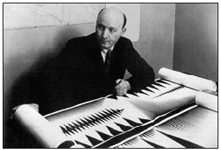
1. Data is Nature has links to interesting papers (in PDF and non-PDF form) on synthesthesia arts, including historical attempts to render sound waves as visual patterns (illustrated with gorgeous Deco drawings such as the one Oskar Fischinger is holding in a vintage photo) and a connection between Vasarely paintings and music.
2. Matt Stoller offers an interesting way to rebut arguments that "the free market is always right" (we know it isn't, hence McDonald's and Pixar movies). In his post he applies the economics of the "lemon theory" of used cars to some recent southern California legislation to ban fast food. The comments have rebuttals to his rebuttal.
3. Nice hiphop instrumental mp3 "Introducing...Intro" [link] from cratekings, recommended by disquiet.
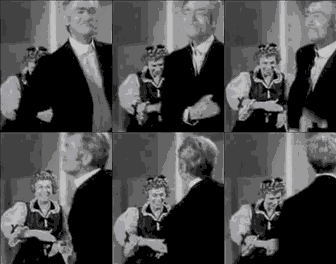
4. For some reason Jed Clampett dances at half speed on Internet Explorer and normal speed on Firefox. We need some dance standards here.

Just a few quick responses to Kevin Zucker's essay for Paddy Johnson's IMG MGMT series, where artists are posting and analyzing collections of images (so far):
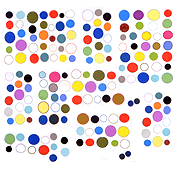
1. After the Christian-Medieval-Corporate mysticism of the Saul Chernick and Kevin Bewersdorf posts, Zucker turns to the Jungian mode of image analysis with "20 Archetypes," a collection of test images (and sculptural models) used for improving imaging and scanning technology--simple, centered forms, outdoor scenes, etc. The essay is both informative and depressing.
2. Zucker's conclusion:
These objects and images (and others like them) have a profound but hidden impact as the building blocks of an increasingly complex vocabulary of digital forms. As future developments in imaging technologies expand on their current capacities, these sorts of mundane archetypes will stay, at least metaphorically, ingrained at their basic levels. In the same way that the 19th century pop song "Daisy Bell" remained at the core of the "dying" HAL’s regressing memory in 2001, the visual artifacts shown here will remain part of the evolutionary memory embedded in the methods machines use to process and describe visual information.
3. The boilerplate objects and images used by the digital imaging technicians, who are not generally thought of as artists, and collected by Zucker for his essay are the soul of mediocrity: Pottery Barn knickknacks, Playboy foldouts, unimaginative nature photography. If these are the hidden infrastructure of entertainment and advertising in the digital era, as Zucker suggests, then HAL save us all.
4. In the history of photography, at some point the artists wrested the medium from the technicians and scientists who were using it and said "Thanks, guys, we'll take it from here." With digital imaging this has not happened because corporate teams, not individuals, are doing most of the "experimenting." The result is lifeless rubbery horrorfests like Shrek.
5. Digital art still has not found its Karl Blossfeldt or its Alfred Stieglitz, thus Pixar today continues down the unbridgeable Uncanny Valley gap of trying to reproduce nature with more and more heavily faceted cones and cubes. Our movies and advertising still resemble Zucker's archetypes. These tropes are not so deeply buried.