BITMAP in Philadelphia - Photos

bitmap drexel

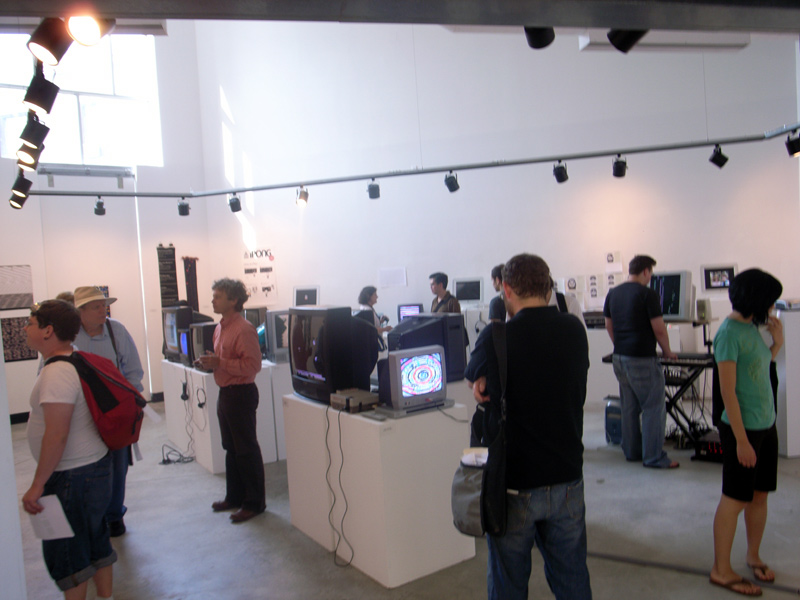
The gallery of the future: nothing on the walls, all work is on monitors in the center of the room...

More pictures of "Bitmap: As Good As New" at The Leonard Pearlstein Gallery, Drexel University, Philadelphia, can be seen on the vertexList blog. Am proud to have work in this show with other 8-Bit artists (versions 1.0 and 2.0). That's my TV bought on clearance in the center.
Spiritual, Faux Spiritual, Non-Spiritual

Artist Saul Chernick kicks off Paddy Johnson's IMG MGMT series with jpegs of Death: historical engravings of skeletal zombies visiting--and feeling up--hapless Everymen and -Women, plus lavish exploded view anatomical illustrations. (At least one of these images graces the opening montage of Dario Argento's recent gorebath Mother of Tears, a movie more people will probably see on the Internet than on the big screen or DVD. In a sense the Argento montage is a juiced up, sexed up, set-to-music version of what Chernick has done.)

The premise of the IMG MGMT series (as in image management), which this blog will be participating in soon, involves artists curating images off the Net, either because they routinely do that in their work or simply because more artists are exposed to or otherwise glom onto this material with the effect that it slowly seeps into their work (or doesn't). In a sense We Are All Surf Clubs now, which is one thing that might be upsetting the conceptualist geeks who populate the Rhizome chatboards--"what makes us special if everyone can do this?"

The second installment of IMG MGMT is from Spirit Surfers co-founder Kevin Bewersdorf, who seems on a mission to find an ironic sacred in the dead, materialist Internet. The spirit surfers call themselves infomonks and offer up art content as "boons" to the viewer. The title of the IMG MGMT post is "Stock Photography Watermarks as the Presence of God." Images of praying or touching hands all bear the ubiquitous numerical watermark of the stock photo site where Bewersdorf found them--an insignia he cheekily equates to a religious talisman, thus indicting the dogma-like aspects of the corporate world's copyright-worship.

The Chernick and the Bewersdorf posts are similar in the following ways:

1. Both are collections.
2. Both are presented as a top-to-bottom visual list.
3. Both are not the artist's "normal" work. That is, both artists exhibit "made" things, although as a surf club member/co-founder Bewersdorf is involved with "finding" as art.
4. Both have explanatory text.
5. Both deal with depictions of the sacred or otherworldly.

It is probably too early to draw conclusions from this but what the hell. The internet is a dead machine environment, a lifeless series of protocols experienced through little screens and tiny speakers. Beginning with Tron's "religion of the User" and William Gibson's voodoo gods haunting Cyberspace (in the Neuromancer books), artists have attempted to invest this domain-of-domains with qualities of the spiritual. It is almost an imperative.

Two artists who are having none of this are jimpunk and Damon Zucconi.

Jimpunk is an anarchist obsessed with American Media Shit (or American Shit Media). Here are some links to recent posts from Triptych.tv, his blog with Linkoln and Mr. Tamale:

doc.wrt #2 (this one pulls up something different every time you click it)
On Summer ≈ ∞
▤ off spring
[▭] paint:n6

pink flamingo
Re

CrystalBeastTopazTigersunflower.mov

Many of these are Jitterized or otherwise scrambled media quotations, reiterating America's insane hold on global culture. They are not "icons," however, but de-iconized by adding/subtracting visual information, layering and adding harsh buzzing noises. This is no info-monastery, more like a nihilist party scene from an '80s film that runs 24/7.

Damon Zucconi has curated a selection of works at Club Internet (click the wand thing in the upper left corner to change images) that are more phenomenological/fluxoid than spiritual. He scours the net for embedded media "moments" involving some kind of fleeting or half-perceived event, for example:

--"wait--what were those guys doing in that building we just passed? were those racing helmets? space helmets? aim the camera that way, try to focus"
--image of chair brightens and darkens
--camera zooms from pedestrian view to outer space
--scene from 12 Angry Men with added lens flares
--flashlight view of spooky cavern montage--things almost come into full view
--viewer rotates illegible 3D logo
--long distance views of billboards (?)
--rotating bladelike CAD objects
--microphone scrapes tree bark
--found photos with animated smoke, mist, etc

In other words, click a link and stuff happens (or not). Zucconi's taste tends to the arch and the slight but one appreciates the hands off, distanced, wtf? quality of much of this work. One exception to the lack of a religious theme in this group is James Whipple's vocoderized graphics demo where the droning language of a corporate instruction video acquires the uplifting cadences of a sung liturgy.

Tomorrow: Dallas Video Festival

new monuments

Opening tomorrow night, I will have work in the Dallas Video Festival, along with Marcin Ramocki, Cao Fei, Matthew Barney, and others. Details from the KERA TV blog:

Video art is about to get what may be its most serious and thorough treatment ever in North Texas. Beginning Saturday, the Video Association of Dallas, best known for putting on the annual Dallas Video Festival, hosts a five-week series of video programs, installations and performances at Conduit Gallery.

Curated by art critic Charles Dee Mitchell, multimedia artist Carolyn Sortor and VAD founder Bart Weiss, “The Program” opens at 5 p.m. with a reception, followed by the screening of a 90-minute video compilation. The work will stay up until it’s replaced by a new wave of video and installations each Saturday.

This week’s works include Drawing Restraint 13 by Matthew Barney; RMB City - A SecondLife City Planning by China Tracy by Cao Fei; online access to Serpentine’s website exhibition opening of RMB City; Torcito Project by Marcin Ramocki; New Monuments, Endnotes and Hoedown compilation by Tom Moody; and The Arrangement of Two Opposites While their Maximum Contact is Under Generation by Yves Netzhammer.

The night also includes a talk on Drawing Restraint 13 at 5:30 p.m., a live performance by Treewave at 8 and an after-party performance by Apples in Stereo at Sons of Hermann Hall at midnight (ticket required).

Free screenings also will be held at the Modern Art Museum of Fort Worth at 7 p.m. on Aug. 5 and 12. And the Dallas Museum of Art will host free screenings and a panel discussion at 1:30 p.m. Aug. 10.

More details from Carolyn Sortor's blog. Festival screenings (more accurately video installations in a multi-part exhibition she co-curated called "The Program," occurring over five weeks) also include work by my fellow Nasty Nets alums John Michael Boling & Javier Morales, Joel Holmberg, Guthrie Lonergan, Michael Bell-Smith, and Paul Slocum (performing with Treewave), plus Rick Silva, eteam, John Bock, Kristin Lucas, Kenneth Tin-Kin Hung, and other artists.

Above: detail of still from my video "New Monuments."

Update: Sortor mentions on her blog and I want to note here that one of the three vids I'm showing is "End Notes," which includes animated GIFs I made in collaboration with jimpunk.

Update 2: Photos of the opening.

Steven Parrino Fact Check

There they go again. The New York Times is turning the late Steven Parrino into a misunderstood Van Gogh figure. Per writer Dorothy Spears:

For years, when the artist Steven Parrino wasn’t jamming power chords on his electric guitar or tinkering with his motorcycle in his garagelike studio in Brooklyn, he was recycling his unsold paintings: twisting them into eccentric new shapes, smashing their stretcher bars or stabbing them repeatedly with scissors.

His destructive approach to art making earned him the admiration of some fellow artists, but it also concealed a painful reality: There was no market for his work. In eight years and five solo New York shows, his former dealer José Freire [of Team Gallery] said, he sold only two of Mr. Parrino’s paintings, one for $9,000 and the other for $10,000.

Parrino is now a hot, posthumous Gagosian artist, we're given to understand. Based on one quote from a dealer who no longer represents the Parrino estate, the Times--"your place for one source shopping"--claims Parrino had no market. But what about all the other solo shows on his vitae, most of them in Europe (at least 25 non-Team exhibitions)? Spears recounts a secondhand story of a Swiss dealer complaining he couldn't sell Parrino's work, but the source of this tale isn't clear. Spears quotes a fax Parrino ostensibly sent a Swiss curator "instructing him to remove all of Parrino's work" from the dealer's gallery but there is no quote indicating she talked to the dealer himself. The dealer's gallery is not named.

Spears' tale of woe prompted the anaba blog to ask how Parrino made ends meet, to which query an anonymous commenter eagerly chimed in that Parrino was "supported by his wife for a good amount of the time" Parrino was showing at Team.

The BS is clearly flying.

A different picture of the Parrino balance sheet is suggested by people who knew him, posting on artist Bill Schwarz's blog. According to these commenters, Parrino had a career and a reputation in Europe and sold work there, and the "only sold two paintings in his lifetime" legend the Times attempts to foster is misleading. As for the "wife support" claim, during an approximately 21-year working career Parrino was married for 6-8 years. According to Lisa Ruyter, artist and co-founder of Team, chiming in on the Schwarz thread, Parrino was not married while at the gallery. One commenter who knew Parrino later in life doubts he was selling much, saying the artist was "hot" in the '80s and "not" from the '90s onward.

An artist's means of support is generally not relevant to anything and this blog wouldn't talk about it. Unfortunately the "newspaper of record" has made it relevant by suggesting a relationship between Parrino's content (recycling, destroying artworks) and his economic status vis a vis the art world. This doesn't square with what I know of Parrino's aesthetic. Sometimes nihilism does mean nihilism, prompting the people it makes uncomfortable to explain it away as career frustration.

Related: An earlier post on how the Times' Parrino obit subtly added to the artist's legend (while not deigning to praise his work). And more corrections of the Times Parrino obit: Parrino did not consider himself a "Neo Geo" artist.

Update: More from anaba.

Update 2: This post has been revised to include the Times quote and a few afterthoughts.

Update 3: And continues to be revised, WIKI style, as new facts and opinions come in.

Update 4: For the Lisa Ruyter referred to in this post see Francis Ruyter.

Maker of "Go Fish" Sues Kids

AB NewsWire, July 23:

HasBeen Games, a closely-held corporation owned by the Eli Sneed family for several generations, has recently taken an aggressive copyright stance to protect its interest in several popular games, including Go Fish, "Indian" style poker, and Duck Duck Goose.

"When I saw a knockoff of Go Fish on Facebook, steam came out my ears," says Beavis Sneed, the current CEO and great-grandson of founder Eli.

In addition to suing Facebook, HasBeen is also dispatching private detectives to summer camps around the US, in hopes of stanching unauthorized playing of Go Fish, a game developed and copyrighted by Eli Sneed.

"If one of our operatives hears your child say 'Give me all your fours,' Mom and Dad, you will be receiving a letter from an attorney by the time Junior gets home," a statement from Beavis Sneed's office says.

"This is no fishing expedition, but you will be netted," stated the statement.