
18-wheel truck behind billboard-like structure of colored Plexiglas in outdoor installation
laboratory mouse hutch and illegible placard in Plexi vitrine
house key transformed into "phat" surrealistic object through nickel-brass galvanization
photo of about 40 ornate "keys to the city" of various municipalities (supposedly)
five cast alloy keys from New York art gallery made using FBI key duplication method (supposedly)
ring of keys hanging on nail on white wall give access into every room of unidentified building (supposedly)
indoor grove of potted trees blocks doorway
fluorescent lights in clear plastic bags of water hang from ceiling in dark room
seminal art photos (Klein's window leap, Burden shooting at plane) made into fictional movie posters
staged photos of various home fires (radiator, cig, etc) with fairly realistic CGI flames
link to essay analyzing post-Fordist economic production as "the communism of capital"
young woman fellates microphone, which makes feedback sounds (Quicktime)
photo of peeling ad poster re: men's shirt sleeve lengths
banyan tree sculpture with back story about Bangladesh "elite" family
patterns on tv monitors are generated by sound pulses; tvs are faced to wall and you only see reflections of the patterns as aura around tv
LCD screen generates numbered sentences which you "own" as art for as long as you remember them
algorithm creates picture frames for world leaders based on how evil they are (supposedly)
sculpture based on 1905 radio transmitter emits distorted sounds from old radio
examples of revolutionary vocabulary ("radical," rebel," revolution," etc) found in commercial contexts--grid of digital images
attempt to track down and photograph all 312 people mentioned by name in the 28 February '07 edition of a small local newspaper in Hamburg
the movie Blow Up blown up much larger than your browser
reduced front pages of all printed national newspapers from around the world on one web page, aggregated daily (supposedly)
photo of potted plant with white paint spattered on leaves; photo of folded leathery (paper?) surface
long list on non-functional drop down menu of items the artist wants to know
video/sound art collaboration with white screens and speakers--patterns on vids are "concrete visual representations of sound"
funeral-wreath-cum-chocolate-box, on tripod
parade float bric-a-brac on pedestals surrounded by oversized drawings (whale, cowboy boots, etc)
general

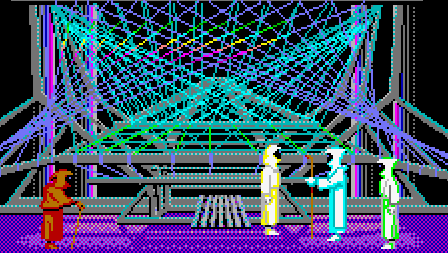
Voyager Is Not True
(but it is kind of good.)
From Wikipedia entry on Ron Moore, TV producer who revamped Battlestar Galactica and briefly worked on Star Trek Voyager:
Moore's re-imagining of Galactica is noted for taking a more serious tone than its [1970s] predecessor, something that was foreshadowed in the January 2000 Cinescape interview, where he discussed what he saw as the root problem with Voyager.
"The premise has a lot of possibilities. Before it aired, I was at a convention in Pasadena, and [Voyager's producers] were on stage, and they were answering questions from the audience about the new ship. It was all very technical, and they were talking about the fact that in the premise this ship was going to have problems. It wasn’t going to have unlimited sources of energy. It wasn’t going to have all the doodads of the Enterprise. It was going to be rougher, fending for themselves more, having to trade to get supplies that they want. That didn’t happen. It doesn’t happen at all, and it’s a lie to the audience. I think the audience intuitively knows when something is true and something is not true. Voyager is not true. If it were true, the ship would not look spic-and-span every week, after all these battles it goes through. How many times has the bridge been destroyed? How many shuttlecrafts have vanished, and another one just comes out of the oven? That kind of bullshitting the audience I think takes its toll. At some point the audience stops taking it seriously, because they know that this is not really the way this would happen. These people wouldn’t act like this."
We were mainly watching it for Seven, Tuvok, and the Medical Hologram.
Hiphop and Peer Review
Disquiet on peer-reviewed hiphop mp3s: an analyis of the site Crate Kings, where beatmeisters trade beats and evaluate them, and post tech talk.
Most of the participants in the dialog post their own work, backing up their words with their own efforts. At cratekings.com, there are several places where users post their beats for the public. One is the Beat Battles forum, where a single sample is shared by competitors who, Iron Chef-style, seek to best utilize it in a rhythmic backing track. There’s also a freeform forum, where a typical heading will read “New Beat. Thoughts Wanted.”
Haven't spent much time there to see how in-depth it is but enjoyed the MySpace-posted songs of Organixlives that Disquiet recommended. Minimal ambient sample-bending provides the hooks and a driving, almost off the shelf beat runs throughout. Initially started listening with the idea that these were just backing tracks for vocals but then started thinking of them as little Philip Glass-like compositions or Varese with a pulse.
A word on "peer reviewed." The way Disquiet uses the term is completely accurate yet turns the notion of peer review, in the academic "final word by experts" sense, on its head. Internet sites such as Crate Kings can be hothouse labs where ideas incubate but they are communities of passion and shared interest and tend to come and go. As opposed to the academic journals where continuities of subject matter, archives, etc are built slowly across decades and unshakeable cults of expertise (Thomas Kuhn's paradigms, if you will) are harder to demolish.
An artist who I have intermittently clashed with on Rhizome.org and elsewhere (rarely productively) keeps saying "there are artists and there are critics and each does his or her thing." (Not a quote, a paraphrase.) Who are the artists and who are the critics at Crate Kings? There are only people with passion for a subject. Cults of expertise aren't good. Everyone has his or her own best way of "articulating" the art, and takes turns playing litigant, advocate, and judge. The internet has made this possible, but demands critical readers. Ironically the artist who reveres criticism enough to give it its own job is a net artist.
Twitter Scalability Meltdown!!!
As the social networking site Twitter has risen like a hot air balloon in a gale force updraft it's become completely snarled in its own guy wires and functions are getting dropped over the side like so much dangerous ballast (archives, IM access, tweets "with others", etc.)
JonW sent me a link to this article which discusses Twitter's scalability issues. (Meaning how it will it grow.)
I have no opinion on whether relational databases or cloud computing are the answer...

...but Robert O'Brien's comment seems likely:
Your assertion that Twitter can't be decentralised conflates the notion of discovery and service. Discovery can be centralised while the service provision can be decentralised. DNS is a perfect example of a centralised namespace with a decentralised service that maps names to ip addresses. Bit Torrent is another. And to over simplify, what you describe in terms of an architecture is typical of many P2P systems - it is just P2P inside the wall.
In a perfect world there is no technical reason why, for example, a twitter type discovery and friend management service couldn't map all message delivery on to a network of decentralised jabber end-points.
The scaling problem comes because Twitter is trying to "capture" all our tweets, control the UX and API, control the namespace to insert themselves as a centralised message utility in order to extract value. i.e. it is the constrains of the business model that makes Twitter have a bundled service and therefore means Twitter (the business/service) can't be decentralised.
Will Twitter "succeed" so that all our "tweets" are owned by Rupert Murdoch or Bill Gates or will the balloon pop in midair? Pass the cotton candy.