Not Cheap, "Green"

Just received a press release from an established alternative space art gallery that has decided to go paperless--as in, no more printed announcements or PR. Instead of saying "we can't afford it anymore" they said they are "going green." The announcement comes in a PDF with green letters and a logo of yes, a leaf. Someone at the institution missed their calling--he or she should be doing public relations for one of the big corporations.

How else could it be spun?

"We have decided to stop paying money to the postal service, which is subsidized by a fascist regime in the US."
"We believe in AT&T and want to use its 'pipes' for all our communications."
"We believe more use of electrons will move the US closer to tapping its valuable coal resources and keeping industry local."
etc.

Evidently they are not reading Ed Halter at Rhizome and haven't learned about the rematerialization of art.

[This page apologized to Halter for trolling him on this issue but finds that's it's too rich a subject not to exploit. There are solid economic reasons why society is "dematerializing" by going paperless and moving former physical activities online. The reason for making physical objects, sending out cards on nice paper stock, and moving into a white cube display environment at this point has to be because you like it (or feel you have something to say that can't be said on a website), not because you are being compelled to by some inexplicable reverse zeitgeist or because you want to scratch the lotto card and be the one out of a million artists who "makes it." On the Rhizome thread* Halter says his word "rematerialization" is descriptive and shouldn't be taken as an endorsement of anything. But he made his argument for it rather well, ironically or not, and this page anticipates its embrace by those seeking to position new media art within a market. At the end of the thread Yves Bernard, one of the curators of "Holy Fire" (the show about selling new media work under discussion), says "Moreover, this immaterial -> material drift is much more than a side-effect: it is just a part of a much larger trend: software is driving the material world, now generating objects and atoms as well as processes, interactions and communications."]

See also: "Protocol" discussion.

*Update, 2011: The Rhizome link has been changed to http://rhizome.org/editorial/2008/apr/1/the-rematerialization-of-art/

today's question

what\'s new?

Large assortment of "what's new?" web-buttons at spiritsurfers.net, in case you need one.

Note how the buttons diminish in height towards the bottom.
(Whether the graphics appear in the boon or the wake is a matter of monastic doctrine.)

Obsessive comparison/collection of cheesy web graphics in blog posts is one of the funnier parts of Net Art 2.0 praxis.

This one is a definitive treatment of the theme [8 MB animated GIF] although not made by a net artist.

Times Has Pity Party for Bloggers

Another dumb New York Times article about bloggers. They really hate us for stealing their juice over there. Someone should write a story about the miserable lives of media hacks, forced to rewrite copy to avoid offending sponsors and always having to aim stories at an imagined 8th grade reader. I'm sure it causes them much stress, although no cases of "death by journalism" have been reported.

Attack of the Clone Tools

The "erasing stuff in Photoshop" genre stubbornly refuses to die. Laura Carton's porn locations minus the porn had wit but the political variants generally seem fake-profound. By now we all know about Stalin's photo alterations and looking for jiggered images is blogger red meat; artists have little new to teach us here.

Altering "Kent State shooting" photos, as art, should not have happened twice. Jon Haddock did it, in work that was widely shown, including the Whitney's "BitStreams" show. Now Josh Azzarella has done it.

The Art to Go blog attempts to explain away the faux pas, but this just makes no sense:

While Haddock had rephotographed tragedies with crucial elements missing (fire hoses blasting civil rights demonstrators minus the demonstrators), he refreshed the horror without attempting to change it.

Azzarella's photos and videos are more poignant. They rewrite history, giving us the illusion of another chance. What if the planes hadn't crashed into the World Trade Center but only flew harmlessly by? What if the National Guard hadn't gunned down students at Kent State*? What if children in Vietnam were not burned by napalm dropped from the sky by Americans, and what if American soldiers had not tortured and degraded their prisoners at Abu Ghraib? (Azzarella is at DCKT Contemporary in New York till May 17. Great two-part interview with him on Modern Art Obsession here and here.)

*that is, what if the bodies of the fallen had been photoshopped out--exactly what Haddock did.

To rephrase Dali, this is the persistence of no memory.

The Rematerialization of Art

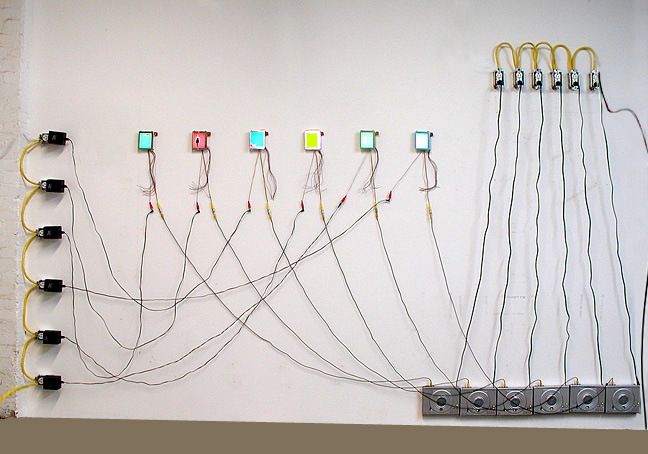
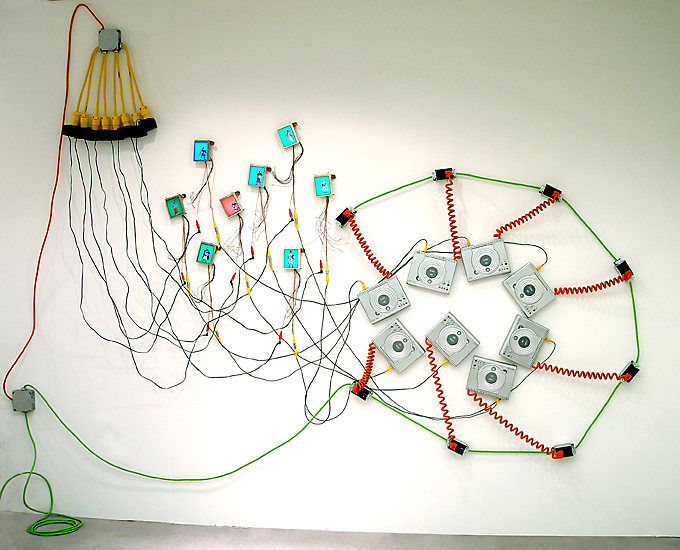
In Ed Halter's formulation [Rhizome link changed--see below]*, as the world becomes more awash in abstract data, Net artists are reifying their formerly ephemeral work and paradoxically diving into the commodity stream. But what to do with all that hardware in the gallery? On one side of Michael Bell-Smith's recent Foxy Production show cables from computer screens were discreetly attached to the wall, taking the shortest possible distance to the Mac Minis hugging the floor and trying their best to be invisible. On the other side of the gallery the wires were tossed around with Cy Twomblyesque abandon. Which brings us to the Baroque phase and Ray Rapp's work, below. This needed to be done and the gesture to be noted--this is where rematerialization leads, with a "hyperrealized" vengeance.

rayrapp_6inrow

rayrapp_installCru

digital video wall drawings by Ray Rapp

Please note that neither sales nor selling have been discussed so far. Halter's rematerialization rhetoric is old news in the art world. The '80s was all about a "return to painting" after the conceptual experiments of the '70s; like Halter, critics came up with a term to defend a retrograde practice. Back then it was commodification, supposedly a Marxist critique of what the galleries were doing--making bushels of money--that was more of an ironic celebration.
A "net artist" joining a gallery stable merely revisits, say, Jenny Holzer's transition from a "relational" artist tacking up her truisms on New York phone poles to an internationally-feted mega artist using increasingly bombastic (and highly sellable) LED displays (similar to corporate stock tickers).
The rematerialization part isn't new and the sales part isn't interesting.
After the Halter thread on Rhizome I had a phone conversation with Aron Namenwirth of artMovingProjects, where I've been showing work. He's been mixing media and non-media in his gallery, and felt the reason for materializing art (forget the De- or Re-) was to get it into a public space where people could look at it, hear it, and talk about it. When we were doing the "Room Sized Animated GIFs" show and the BLOG project space we were talking mainly about how to translate theretofore privately-consumed Web work for a "commons" where people would be walking around and presumably would not want to be bored. Believe it or not, some people have a jones for a white box space and seeing what happens in it. Doing the shows required a hybrid thought process of thinking about what was important online and what was important in meat space/meet space. Yes, we talked about the f*cking sales process, a necessary part of keeping the gallery doors open, I think, but the excitement of the shows was, um, the shows.

*Update, 2011: The Rhizome link has been changed to http://rhizome.org/editorial/2008/apr/1/the-rematerialization-of-art/