
Washington Post maps show the ethnic cleansing of Baghdad courtesy of American tax dollars. The Sunnis have mostly fled and mixed ethnic neighborhoods (Sunni, Shia, and Christian) are just about gone. Not depicted are the high concrete fences around neighborhoods enforcing the Bush/Petraeus notion of peace. Which is better, to live under a dictator propped up by oil money or death squads propped up by foreigners who want the oil? Either way, it wasn't America's choice to make.
general
Wall Street Journal on Pro Surfer Artists
This Wall Street Journal article by Andrew Lavallee attempts to make sense of some of the Net Art 2.0 content that's out there: he zeros in on a group of artists who find boring Internet content interesting. Yr humble blogger is both that content (peripherally) and its regurgitator: The article discusses Marcin Ramocki's Blogger Skins piece (where "Tom Moody" is one of the five "google portrait" subjects) and the Nasty Nets "Internet Surf Club," a group blog where I've been posting work.
The most thoughtful quote comes from Guthrie Lonergan,* who talks about defaults in our culture. He is broadening a technical term--a default is what software ships with as opposed to what you add--to include any kind of societal trope or habit, and (it could be further elaborated) his artistic practice involves using the Internet as a lens to reveal these. The example given in the article is the MySpace intro. Lonergan notes that MySpace doesn't provide a template for this, so people "default" to a kind of telephone answering machine greeting when they first make their pages, with added images.
Taking Lavallee's article a bit further: Ramocki's Google portraits are also a collection of defaults or habits--the Googlebot assumes any photo with the caption James Wagner is James Wagner and doesn't make any further investigation such as: Which James Wagner? Is a caption misplaced? So you end up with a "portrait" of 100 images of James that is a collage of largely irrelevent crap. It is visual proof that the systems we increasingly rely on aren't as smart as they're cracked up to be.
Much of the humor on the Nasty Nets site centers around glitches and technical failures in our brave new cyberworld--it's not just about artists slumming or "looking at the world around them" or "searching for inspiration." And the practice isn't just bookmarking-as-found-object-finding. Manipulation of the found content also occurs, often using default tools such as Photoshop, iMovie, MSPaint, or an off-the-shelf MIDI sequencer.
*Update: On his del.icio.us page Lonergan says, regarding the MySpace intro quote: "The observation about answering machines is a paraphrase of something Sean Dockray said about the MySpace vids."
earcon's Party Lion CD
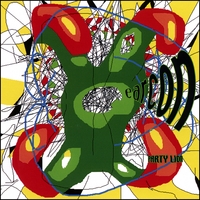
Recommended: earcon's Party Lion CD, available at CD Baby [dead link]. Tuneful electro with just the right balance of refinement and raunch. Yours truly did the (8 Bit) cover drawing. Also at the link is an interview I did with earcon (aka John Parker) a few years ago, which describes his music and working methods. I'm slightly less ignorant now than when I wrote those questions but the answers are as good a blueprint for a sound artist/musician as ever.
Update: more info about the CD on Parker's site.
More on Slocum Sample Remixer
Even bloggers must take vacations and I am on one.
I felt that I attempted the impossible interviewing Paul Slocum last month about his sample remixer without actually having used it: the Q&A went on and on but it was like the proverbial sight-impaired men describing the elephant.
So I traveled to Texas to get a demo (and visit family members).
In the interview I asked Slocum how his software differed from Cubase or similar music production programs.
The differences are described below.
Like the sample remixer, Cubase allows you to load a long (song length) sample, cut it up into any number of clips of varying lengths, place those snippets on tracks so they play simultaneously or staggered, with on-off commands triggered by a vertical cursor passing through all the tracks. You can also copy and paste any number of sub-sequences of clips to other points on the editing grid.
Where the Slocum sample remixer differs:
1. The random loop point finder is a quick way to generate interesting-sounding clips and add them to the grid.
2. The interface is very fast because it is text-based. In other words, instead of wasting CPU resources drawing graphics of clips (with little pictures of the waveforms), the Slocum device simply shows an asterisk against a colored background.*
3. The point is not to make conventional music with a common tempo and key--the goal is abstract or semi-abstract music that is polyrhythmic, a-harmonic, and glitchy sounding, yet obeys a set structure. One could do most of this is in Cubase or Sonar but not as quickly or with the same sense of liberating experimentation this device gives you of creating random loops on the fly. (I don't know how close it is to Ableton live in terms of speed.)
4. The interface is elegant and "lo-fi"--like an ASCII version of Cubase.
*Afterthought question for Paul: how long is an "asterisk"'s worth of music? Is it the entire length of the sample, or does the on-off grid cut it off at the note length? (I assume it's the latter.)
Update from Paul: "The asterisk is a half measure of music. So a half-note at whatever you have the tempo set to. "
Robot Pop
1991-ish quote from Kraftwerk's Ralf Hutter, from Simon Reynolds' "retroblog" of published and unpublished writings:
"The mechanical universe of Kraftwerk has been cloned or copied in Detroit, Brussels, Milan, Manchester, and even psychedelicized by the delirium of house music. You can define it as you want: sci-fi music, techno-disco, cybernetic rock. But the term I prefer even so is robot pop. It fits in with our objective--which consists of working without a respite toward the construction of the perfect pop song for the tribes of the global village."