
Net Art 1.0 Definition Reconsidered

chakras

Just as Nasty Nets, a premiere Net Art 2.0 site, is in the process of winding down or metamorphosing into the next stage of The Alien [or not --ed.], comes artist and blogger Twhid with this post quoting language from an Israeli Net Art show. This could be a working definition of Net Art, or what we're now calling Net Art 1.0:

--the visualization of data
--open-code access and connectivity
--hacking and online voyeurism involving critiques of authorities and economic powers
--the creation of online behavioral codes and the negotiation of cyberspace from various perspectives

Much of this sounds dated and quaint when vast legions of creative people have found comfortable homes in Rupert Murdoch's MySpace. What is still relevant, using Nasty Nets and some of the other surf club blogs as examples?

I'll throw these out:
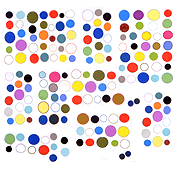
1. Camille Paloque-Berges owns "visualization of data" in a Web 2.o sense. She has an exquisite eye for scientific charts and online graphics and appropriates them for her various blogs (here's one, where I got the above image). But often stripped of context and presented as Dada, a la Francis Picabia's pointless machines. Or heightened (enlarged, cropped) to be contemplated for their pure aesthetics. Or interspersed with rank kitsch. The functionality of these confections is also occasionally considered so it's not pure nihilism.

2. Open code access. Everyone still supports this is in principal but as Alex Galloway has pointed out even the rhizomatic web has its protocols. And often people just accept proprietary systems (e.g., Windows) because it's the language of the workplace, where serious surfing, er, online research, gets done by many. Or use YouTube and MySpace because they are a way for creatives to talk--until the Man shuts you down.

3. Hacking. See hacking vs defaults discussion on Guthrie Lonergan's and my blogs. Rhizome/NewMu should have consulted this in picking the "Unmonumental" show!

4. "Online voyeurism involving critiques of authorities and economic powers." This is grant-ese. We'd have to know what it means to grok it in a 2.0 sense. The best critiques of authorities lately have come from political blogs but that has nothing to do with Net Art.

5. "The creation of online behavioral codes and the negotiation of cyberspace from various perspectives." This is where Lonergan and the other surf bloggers shine. Chat room anomalies; confessionals on MySpace; recycled vernacular photography and video; interesting error messages on corporate sites. Somehow I don't think this is what the Israeli exhibition had in mind, but I could be wrong.

6. And then there's this texturemappingpalooza of Borna's--a weird, wonderful, sardonic use of browser space for computerphilic/phobic art, communicated via blog. Where does this fit in the dry scheme of Net Art 1.0? Nowhere, I'd say.
Rumors

Rumors behind the demise of the Nasty Nets "internet surf club":

--Art blogger called the site mediocre and noobie club member dissed her.

--Museum cherrypicked NN members for show and internal tensions tore group apart.

--Influx of personnel from rival crews after "beef" altered group mission.

--Porn company offered founders a sum they couldn't refuse for the URL "nastynets.com"

But seriously...

The Nasty Nets blog has been replaced by a hilarious, giant puppy with strangely human eyes that follow your cursor around. This has been for almost a day. If this is a fit of pique by the site's founder(s) it's a good one.
But damn, at least when I pulled the plug on my blog I left the content online!
Ah, I don't care, it's not like we had a contract , it just means I'll have to repost some of my NN material here.
I do hope the group does a DVD--maybe self-released with all the material currently in folders on the website????
And then maybe a separate DVD with the "secret stash" and html files of the blog posts?
I can help a little and will certainly promote it from my tiny corner of the blogosphere.

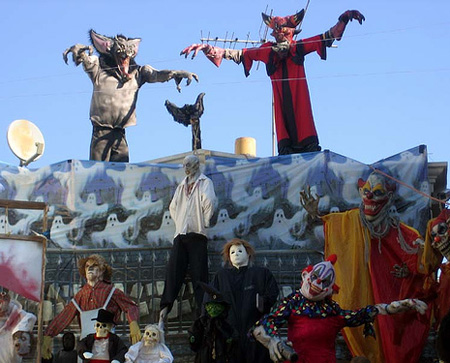
Update: One should never listen to rumors, or pass them along on the Internet. Nasty Nets did disappear for a day, but it was apparently a Halloween prank. Or possibly one of the discussion threads got too weird, with critical words flying hither and thither, and needed to be cooled down with a puppy. Anyway, Net Art 2.0 still lives, and NN work product is accessible to all.

Blogger Skins

The online version of Marcin Ramocki's "blogger skins" project is here. As mentioned previously, the premise of this artwork is to assemble portrait collages of the first 100 images that come up when you Google search "Paddy Johnson," "James Wagner," "Joy Garnett," "Regine Debatty," and "Tom Moody" (the common denominator is that all the subjects have been fairly active bloggers for a while).
Clearly Debatty, who publishes the blog We Make Money Not Art, is the most successful personage among us, as the first dozen hits are photos of her. This means people with huge amounts of Google juice have linked to her and pushed these images to the top of the heap. Garnett is the most successful artist, as it is her paintings that fill the top slots. James Wagner is disadvantaged by having a common name, while I have been sharing Google with an Austral1an cr!cket pl4yer and co4ch for many years now. The drawings occupying the #1 and #2 slots for my name are actually drawings by me published in a Dallas zine when I lived there years ago. Almost two decades later and the artist is still sniffing the critic's butt and shining the curator's shoes.

Update: Photos of the work installed in a gallery are here. The piece deals with identity construction in the digital age but as I've said before that is generally cause for despair. Some people really obsess over Google ranks but they're peer review in the most imperfect sense. When you are mingled with someone that has your name it's more like recombinant genetics than identity.

Gertrud Orff vs Nino Rota (for Kids)

mp3blogging; tracks temporarily posted:

Gertrud Orff: "Kleine Klavierstucke, Heft 1 Nr.2" [0.7 MB .mp3]

Nino Rota: one of "Seven Difficult Pieces for Children" [1.1 MB .mp3] (hat tip SHM)

These piano pieces couldn't be more basic but much is packed in here. Both have a main theme that plays twice, a second theme (not really a chorus), and a reprise of theme one. They are almost national stereotypes, the Orff precise and unornamented, the Rota playful and filigreed. Theme one in the Orff resembles a playground song, theme two a folk dance. In the Rota it's reversed--the playground tune nests inside the folk tune, which has that inevitable circus "oom pah" that makes Fellini Fellini.
I like them both, but prefer the Orff. Besides being exquisitely organized, it's profound. It seems more about the loss of childhood than something a child would play.

Update: This post has been revised: it mistakenly identified the first piece as Carl Orff's when it is in fact Gertrud's--his wife from 1939-1953. (The CD is less than clear.) I'm letting myself off the hook somewhat because this piece is the most Carl-like tune in her "Kleine Klavierstucke" suite: the rest are almost Debussy-like in their delicacy and have a half-sketched, Eastern quality (the CD liner notes liken them to Sumi brush painting).