Upcoming NAMAC Panel in Austin

I have been invited to be a panelist for the 2007 NAMAC Conference in Austin, Texas, this Saturday, October 20, at the Sheraton Austin (701 East 11th Street, 1:45 pm - 3:15 pm). NAMAC (National Alliance for Media, Arts and Culture) is a nonprofit support and advocacy association for independent film, video, audio and digital arts. Here's a list of panels, including one with Richard Linklater; the one I'm on is "From the White Cube and the Silver Screen to the Black Hole and the Color Field: Moving Around and Beyond the Institution," and my fellow panelists are Laurence Miller, co-director of Austin's Fluent-Collaborative art space, Brian Fridge, Texas-based artist, and Kristina Newman-Scott, visual arts director of Real Art Ways in Hartford CT.

My thoughts on the panel (previously communicated to organizers and/or panelists):

--Regarding the title, I asked the organizers how they meant "color field," since that is a type of painting that is actually the epitome of "white cube" art, encompassing Kenneth Noland, Jules Olitski and other late Clement Greenberg-championed artists. The organizers said they meant something beyond that and into some some sort of amorphous space where new work exists free from museum constraints.

--Nevertheless, I have issues with the implied directional arrow in the panel's title. The white cube may have transitioned to the "black hole" (of cyberspace? media art?) but unlike transportees to the starship Enterprise, the white cubers are still extant and doing their thing down on the planet's surface. In fact, most cubers don't believe there's a ship up there. They are thriving in a market based largely on medieval tech (painting).

--What I'm interested in as an artist and blogger (to continue the lame Transporter metaphor) is to beam back and forth between the two worlds and gradually figure out "the rules" of what works best in the respective environments. Net art has mostly failed in the gallery setting, and the gallery experience translated by means of text, jpegs, and/or flash files communicates imperfectly online. What works across this barrier (in either direction)? Why?
Bubbly Fish

bubbly fish - optiDisc

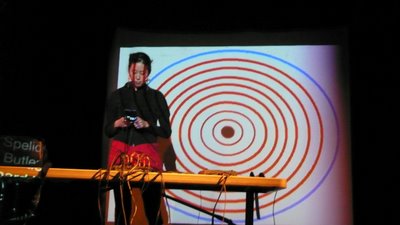
Aron Namenwirth's photo of 8-Bit/Gameboy musician Bubbly Fish performing at Galapagos Sunday, while my "OptiDisc" animation pulses benignly in the background. Her techno stylings with interwoven videogame blurts, chirrs, and blats are always a pleasure to hear.
For some reason just noticed that Jeremy Kolosine (aka Receptors) released an 8-Bit tribute to Kraftwerk on Astralwerks featuring Bubbly Fish, Bit Shifter and other performers in the scene. Looking forward to hearing that.

Jillian McDonald's Screaming Video

One change to the "Abstract Horror" video/performance lineup at Galapagos two days ago: Jillian McDonald showed her vid Screaming rather than the piece scheduled. It was a hoot, literally. She digitally inserts herself into peak moments in horror films, usually some ultra-disgusting transformation scene or "final shock before the credits," and screams her head off. She has cleverly picked moments in all the films where the beastie bolts off camera right after its monstrous appearance (for example, the chestbuster's 23 skidoo in Alien), so her screams appear to be aggressive rather than defensive, frightening the monster off. I'll leave to feminist scholars the explication that this is a reversal of the usual domination scenario implicit in commercial horror films and just say that it's McDonald's dry humor that saves it from an art-deadening abundance of social agenda. Her facial expressions immediately before and after The Scream--and there are a lot of Screams in this video--say, respectively, "Oh, God, another posturing prick to be dealt with" and "What the fuck was that about?"

Uses of links by bloggers vs online print journalists

This is pretty obvious but apparently isn't obvious to print media trying to get hep to the whole online thing. From Daily Kos:

Bloggers use links to give readers the opportunity to view their source material. When a blogger makes an assertion, you can typically check the validity of that assertion by following links to that blogger's source, and decide for yourself whether it's been properly analyzed.

When traditional media use links, they tend to point to that media outlet's collection of archived articles on the proper noun they've attached the link to.

So when a blogger says, "President Bush today announced his intention to invade Liechtenstein," that blogger would tend to attach the link to something like "announced his intention," and have it point to a newspaper article or White House press release containing a quote from Bush, saying, "I intend to invade Liechtenstein."

When a newspaper says, "President Bush today announced his intention to invade Liechtenstein," the links are on "President Bush," and "Liechtenstein." And they link to archived articles about President Bush and Liechtenstein, in every other context in which that paper has written about those subjects.

Useless.

Unless, of course, you don't know who President Bush is, or more plausibly, what Liechtenstein is. In which case the links are perfect.

The Kos post is patting Frank Rich on the back for using substantive links--he's one of the few writers at the New York Times who does. Of course, his articles will soon be full of link rot (old, broken links) like my blog posts are. The issue for me isn't so much that substantive links are great--they can be annoying distractions and lead to lazy half telling the story, like I did a few posts back. For me the issue is how stupid the Times' fake links are.

Notes for Demo Tonight

Notes for an intro I may or may not give at Galapagos tonight. (Either way it won't be this long and involved--I only have a minute or so to talk.)

Although this was billed as a performance it is actually a demo.
The "demo scene" emerged in European computer geek culture.
Programmers got together and set up monitors on folding tables and showed each other what they were working on.
Tonight I am demo-ing a CD of music (four songs dj-ed together into a continous mix) and a DVD of 15-20 animations.
The two will run simultaneously--the points of contact between them are fairly random.
Although I'm calling this a demo I'm not a programmer, but an artist using a home computer to make images and music.
The visuals are as "original" as the software allows--I try to use the simplest programs so it is clearer what is "mine."
Some of the images originated on the Internet but all of those have been manipulated or added to.
The music is all "mine"--i.e., it's all live synthesis written and performed by me and tracked down for CD, although the music-creation software programming and hardware wiring is a "default," that is, someone else's work.
All of this content (images and audio) has been published to the web on my blog(s).
Part of the reason I'm demo-ing it is to see how it "scales up" to big screen projection and a club-sized PA system.
I tried to pick work that was fairly transparent and iconic--that would read or sound clearly no matter what the environment.
We'll see if it works.