
Articles explaining the current "wild ride" of the Dow:
Nouriel Roubini's blog [link was dead - updated 1/3/2010]
Andrew Leonard on Salon (prob. subscription only)
Articles explaining the current "wild ride" of the Dow:
Nouriel Roubini's blog [link was dead - updated 1/3/2010]
Andrew Leonard on Salon (prob. subscription only)
Several nights ago Bill Kristol appeared on Jon Stewart's TV program, describing a recent Baghdad trip and assuring us that Bush's Iraq war escalation is working. Atrios touted this as real journalism--maybe that was ironic? Kristol edits the neocon Weekly Standard and espouses views as bloody minded and hawkish as you'll find. But he came out smiling, Stewart greeted him warmly and they joked around as Kristol repeated over and over that things were going well in Iraq and if we'd just give General Petraeus more time everything would be ducky.
A supposedly hard hitting question from Stewart was "why are you so angry at people who opposed the war?" Kristol never stopped smiling and said "I'm not angry at them" and jokingly assured Stewart that Bush doesn't think that Stewart is a coward.
They had some back and forth schtick, the audience laughed, and applauded when he entered and exited. Stewart clearly values having Kristol on his program and wants to maintain cordial relations with him.
What we needed to see was the smile wiped off Kristol's face by the reading of statistics about the increase in civilian dead in Baghdad post-escalation, the growing chaos in Basra and points north, and some recitation of actual words from Kristol's magazine tarring war opponents as blind to terror or what have you. Stewart's show is a comedy show but he was woefully unprepared and there is nothing funny about Bill Kristol.

Feb 2001 - July 2007, all posts and comments. Much of the printing is double-sided. The images are black and white and there are no links so it's the "zine of the blog." A piece of Internet history, or bulky recyclable? No artist ever knows for sure. Thanks to all who contributed, though--it was in many ways a group effort. The pixel edition is online for as long as Digital Media Tree is online--may it be long!
Rhizome.org has a couple of my images* up on their front page today. Hey, it's the Internet and I don't insist on credit for everything but this is, well, my blog, where I get to mention this sort of thing.

This photo of LoVid performing at Southfirst originally appeared here.
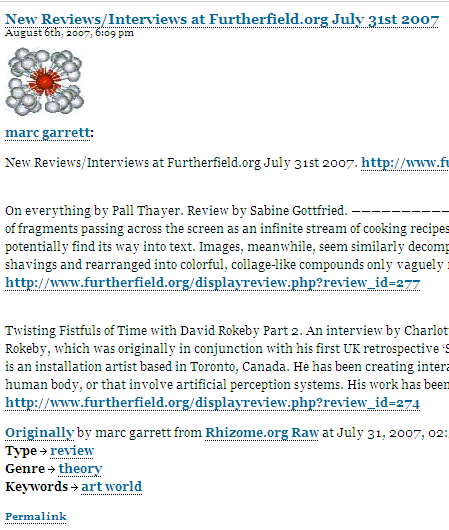
This composite of what I called the "exercise molecules" was used as an illustration of a furtherfield.org article about my blogging activities--the article was also absent from the Rhizome reblogging of the latest furtherfield articles. I mean, they linked to a blurb about the article and that's great and I ain't complaining, really. And it's true the exercise molecules aren't mine (they're found) but it was a bitch putting them together like that in MSPaint where they all retained their characteristic motion in cluster form. (Update: at some point after the above screenshot was made, a mention of the furtherfield coverage of BLOG, my blog-as-performance, was added to the Rhizome post.)
*Update, 2011: The Rhizome links have been changed to http://rhizome.org/editorial/2007/aug/6/new-reviewsinterviews-at-furtherfieldorg-july-31st/ and http://rhizome.org/editorial/2007/aug/15/live-stage-cross-current-resonance-transducer-onli/. Furtherfield's coverage of BLOG has once again gone missing from the former post.
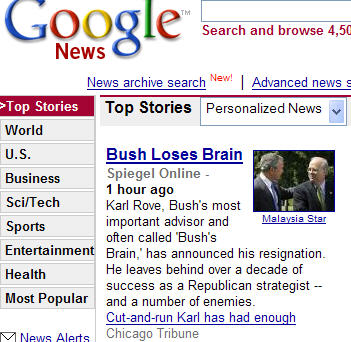
From Sidney Blumenthal on Salon (prob. subscription only):
[After the 2000 election], Bush began governing as if he had a mandate for the most radical presidency ever. The story is told that before the inauguration Bush pollster Matthew Dowd (now another disillusioned and lost soul) wrote a memo to Rove explaining that there was no middle in American politics and that only those who turned out their maximum base through polarization would win. Yet, Dowd memo or not, Bush, Cheney and Rove were prepared to govern as radicals. The theory helped justify what had been decided already.
Only the attacks of Sept. 11 gave Rove, Bush and Cheney an atmosphere in which such theories could thrive through the exploitation of fear. Rove became the public exponent of using terror as a political instrument to demonize the Democrats as unreliably soft. Just before the 2002 midterm elections swept by Republicans, Rove held forth on the coming realignment. "Something is going on out there," Rove said. "Something else more fundamental ... But we will only know it retrospectively. In two years or four years or six years, [we may] look back and say the dam began to break in 2002."
After the Republican victories in 2002, an enraptured press corps celebrated Rove. "Let me disclose my own bias in this matter. I like Karl Rove," wrote David Broder, the lead political columnist for the Washington Post, on May 18, 2003. "In the days when he was operating from Austin, we had many long and rewarding conversations. I have eaten quail at his table and admired the splendid Hill Country landscape from the porch of the historic cabin Karl and his wife Darby found miles away and had carted to its present site on their land."
The 2004 election should have been a foregone conclusion, and perhaps it was, based on the momentum from 9/11. Rejecting Bush at that early point, a year after the invasion of Iraq, would have been an extraordinary repudiation not only of him but of the public's recent and continuing support before it had come to the conclusion that his policies had been given a full chance and were not working. The 2004 election also took place before the further radicalization of policy and politics that was to occur in its immediate aftermath -- the Terri Schiavo case, "the last throes" in Iraq and Hurricane Katrina. Bush and Rove also faced a flawed Democratic candidate and campaign that steadfastly refused to respond to the early smears of Sen. John Kerry's heroic war record, declined to offer any critique of the administration at the Democratic National Convention, and was tentative and inarticulate on issues concerning the Iraq war. And yet Bush still barely eked out a victory, dependent ultimately on slim margins in swing states reinforced by initiatives against gay marriage.
At the St. Regis Hotel, just blocks from the White House, a week after the election, the panjandrums of the Washington press corps hailed Rove at a lunch held by the Christian Science Monitor. "When Rove entered the room, everyone stood up to congratulate him and shake his hand," reports Joshua Green in the September issue of the Atlantic.
Once again, Bush and Rove plunged forward. "I earned capital in the campaign, political capital, and now I intend to spend it," Bush proclaimed. "It is my style." Bush's first proposal of the second term, politically devised by Rove, was to privatize the great achievement of the New Deal -- Social Security. But it never even reached a single congressional hearing room. Soon the winds and water of Katrina washed away the façade. Bush named Rove reconstruction czar for New Orleans. He did little except for the permanent removal of about a quarter million black voters who held the political balance of power in Louisiana.