
...regarding an earlier post:
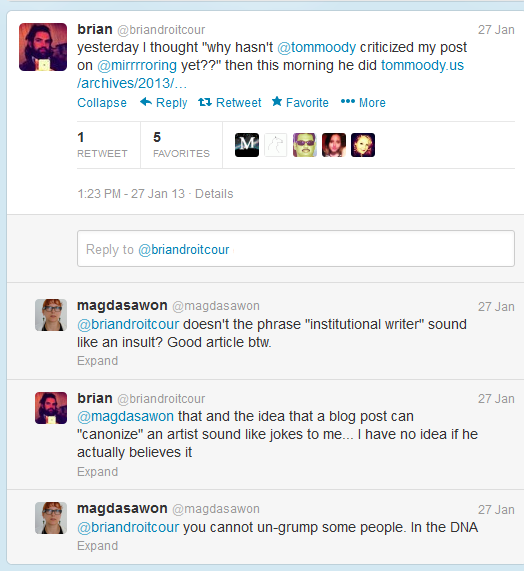
Grump, grump.
On the topic of digital expressionistic painting, here's an essay I wrote for Art Papers twelve years ago that I hadn't looked at in a while.
Very little of the thinking (ranting) there would be revised after all this time. And the digi-paintings covered look much like the work being done now.
Was advocating a multi-platform approach, not in the context of branding but in wanting visual art to be more like drum and bass and hiphop: a sampling aesthetic but also eclecticism of means, where one software program interrogates another within the same work (e.g.. Illustrator quasi-vector rubbing up against Photoshop bitmaps, text smeared into visual content, etc.).
In an essay for Rhizome.org, "Painting by Numbers," Brian Droitcour employs some flawed reasoning in support of Michael Manning's digital painting series "Microsoft Store Paintings."
The essay features three reproductions of paintings Manning made on Windows 8 demonstration tablets inside a Microsoft retail store, as well as Manning's Instagram photo of the outside of a store. The post is tagged "Microsoft Store Paintings." But painting in a Microsoft Store is a joke, right? Microsoft may be Brand A in the business desktop PC market but it has famously missed every recent trend: browsing, search, voice, pods, pads. "Microsoft Store Paintings" also invokes a laugh because everyone knows Apple is the "computer for creatives" due to assiduous marketing to designers, illustrators, and even artists, a contrarian breed typically uncomfortable being associated with a brand (Campbell's Soup notwithstanding).
Yet despite the tag and the pics, the essay tells us that (i) the import of Manning's work is its use of multiple platforms (including the iPad and Apple smartphone), and that (ii) this ecumenical approach somehow disproves tech pundit Bruce Sterling's assertion that the Worldwide Web has broken down into smaller, corporate-branded enclaves.
None of this makes any sense in terms of the critic's role in explaining, justifying, or contextualizing artwork, or otherwise.
Droitcour confesses, somewhat strangely for an institutional writer placing a series of paintings into art history, that "as much as I enjoy looking at painting I don’t really like to write about it." To respond vernacularly: But that's your job, dude.
Discrimination and specificity in writing about painting might help viewers process an impression they have when they click through to Manning's site, which is that the Microsoft Store Paintings look rather different than the iPad paintings: let's go out on a shaky branch and say better, as in crisper, wider, with less self-conscious filtering and special effects, more like paint. This leads to an untenable conclusion: that Microsoft, the also-ran company, got something right, or that Manning found something innately right in a branded product, and that the series isn't just typical smirky new media irony but might raise some intriguing questions about the meaning of a "gesture" and the means of simulating a gesture in the post-painting era. The politics of expression instead of the tired old politics of branding. That's an essay to be written about this work but it doesn't matter because it's already been canonized.
Periodically I check to see if the Mazemod internet radio site is still up -- it is.
The selection there of mod tracker tunes, especially in the "acid" category, is some of my favorite music in the world. These low-res samples triggered from a spreadsheet-like list of commands have a beguiling lighter-than-air speed and guileless one-thing-after-another specificity, if that makes any sense.
Today I enjoyed the following tracks: "Luminessi" by Vesuri, "Fast 96" and "Empathy, State of Mind" by LFO, "Morning After" by Raina, and "Underneathourhome" by Spot. Once something plays in the radio interface, though, it's hard to find it again. You can click back and forth through a sequence but once you reload it's a new sequence, and the selection seems bottomless.
I think most of these were done in the '90s but don't know for sure.
Harvard professor Lawrence Lessig's Tumblr post about the Aaron Swartz suicide, written several days before the Atlantic article I linked to (and read first) dances around the roles of our top academic institutions in the tragedy and makes me less certain now about what Lessig wrote in Atlantic. His advocacy for the scaling back brutal tech laws is appreciated but would love to know what he's not telling us about this case. From the Tumblr post:
Since his arrest in January, 2011, I have known more about the events that began this spiral than I have wanted to know. Aaron consulted me as a friend and lawyer. He shared with me what went down and why, and I worked with him to get help. When my obligations to Harvard created a conflict that made it impossible for me to continue as a lawyer, I continued as a friend. Not a good enough friend, no doubt, but nothing was going to draw that friendship into doubt.
I guess it's inconceivable that a good friend might tell Harvard to stick it. Possibly Lessig's contract as a law professor prohibits him from practicing in Massachusetts or elsewhere. But the Tumblr post raises an interesting issue about a statement in Lessig's later article for Atlantic: "We will never know for sure why Aaron did what he did. Any motives disclosed to his attorneys must remain secret." This is a little disingenuous since from the Tumblr post and the statements linked to therein, Lessig knows what Swartz's motives were, possibly as his one-time attorney. In the Atlantic article he argues in lawyer-like fashion that the motives don't matter (because it's just a contract dispute supersized into a crime) but they actually probably do because they were an element of the government's case. In a published response to the Media Freedom blog last year Lessig says that "if the facts are true, even if the law is not clear, I, of course, believe the behavior is ethically wrong."
As Swartz's lawyer Lessig would have to put the best possible construction on the facts (however unpleasant or reprehensible) in order to beat the government's case. That's what he's doing now, in the Atlantic essay, even though the case has gone away. The Atlantic essay also doesn't mention MIT's involvement with the government's pursuit of Swartz (only JSTOR's declaration of "no harm no foul"). In the Tumblr post Lessig says MIT should be ashamed of its role but apparently the subsequent announcement of a whitewash, er, investigation, by that university took them off Lessig's blame radar.